
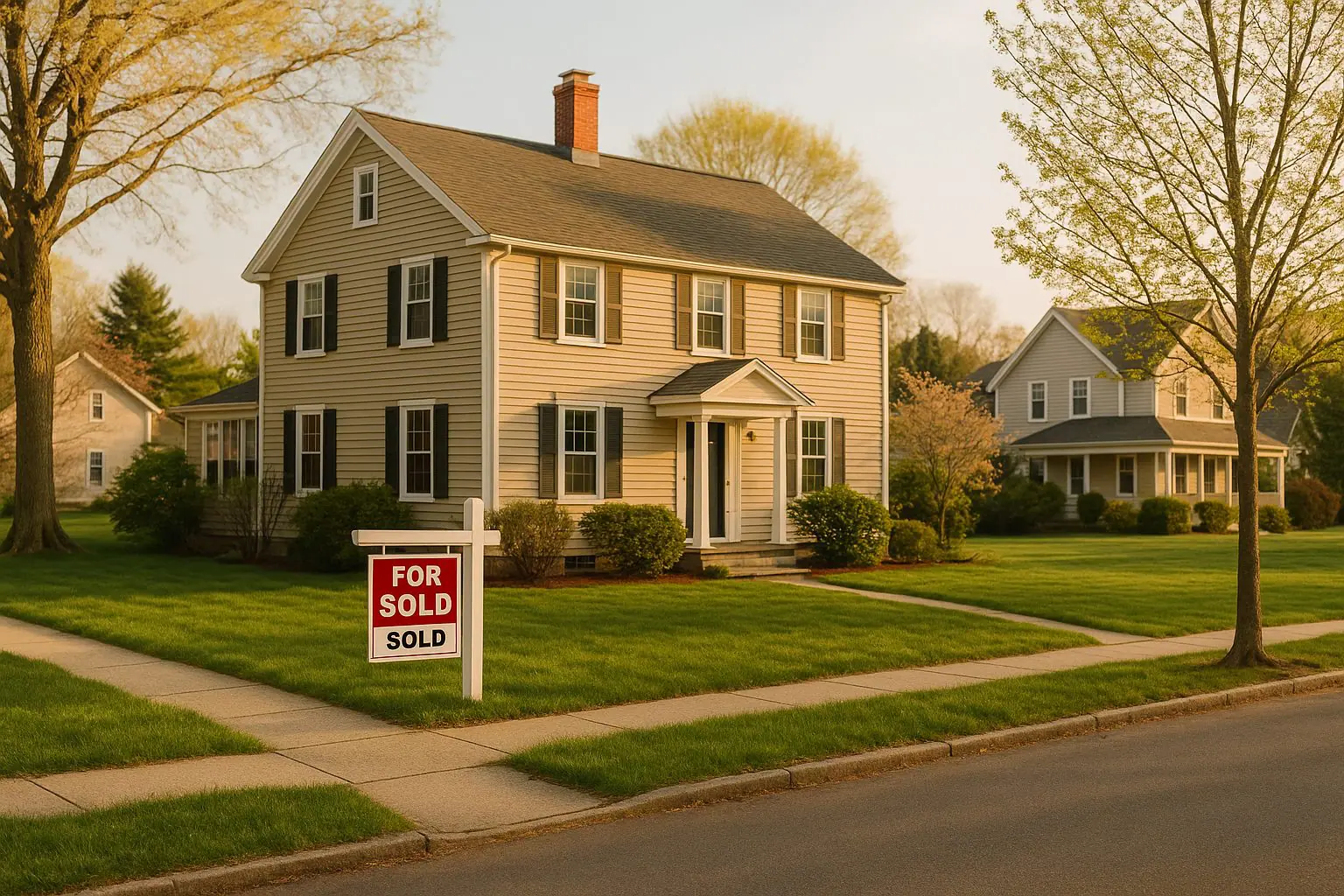
First Time Home Buyer in Mendon: A Guide
Buying a first house in Mendon is not the same exercise as buying a first house in a city, and the differences are mostly underground. Private wells, septic systems, wetland buffers, large lots and a limited municipal water network change what you are actually evaluating and what can go wrong. This is a guide to the sequence — what to line up, what to check before you write an offer, and which public records hold the answers.
What is different about buying here
Mendon is a small town in Worcester County with large residential lots, long road frontage and a housing stock that spans three centuries. Municipal water reaches only a very small area; almost everything else is on a private well, and most properties are on an on-site septic system. Commuter rail does not run from Mendon itself.
The practical consequence for a first-time buyer is that the house is only part of what you are buying. You are also buying a water supply, a wastewater system, a lot with legal constraints on where you can build, and a road that the town maintains on its own schedule. None of those show up in listing photography.
If you want the fuller picture of the town before the mechanics, the Mendon community page is the place to start.
Assistance programs: know the names, verify the terms
There is real money available to first-time buyers in Massachusetts, and most of it is administered through programs you can look up directly. What you should not do is trust any article — including this one — on the numbers. Income limits, grant amounts, loan limits and availability are reset annually, run out mid-year, and differ by county and household size. A stale figure is worse than no figure, because it makes you rule yourself in or out on the wrong basis.
The names worth searching, and who to ask:
- MassHousing — a quasi-public agency whose mortgage products are originated through participating local lenders. It also administers down-payment assistance. Ask a participating lender what is currently open and what the current limits are.
- ONE Mortgage, through the Massachusetts Housing Partnership — a state-supported first-time buyer mortgage offered by participating banks. Terms, income caps and the minimum down payment are set by the program and change.
- USDA Rural Development financing — eligibility is determined by address against a map that is periodically redrawn. Check the specific address on the USDA eligibility map rather than assuming a town is in or out.
- Mass Save HEAT Loan and federal energy efficiency credits — these do not help you buy, but they affect the first year's cost of ownership. Terms change; check the current program directly.
- Your own town — some Massachusetts towns operate an affordable housing trust with local assistance. Call the town hall and ask what exists in Mendon this year rather than relying on a list.
- HUD-approved homebuyer education — required to unlock most of these programs, and worth taking the long version rather than the short one. The longer course covers the parts that actually go wrong.
The single most useful move here is to work with a lender who actually originates these products, not just conventional loans. Ask that question in the first phone call.
Before you write an offer: the Mendon-specific checks
The septic system
Massachusetts requires a Title 5 inspection at transfer for properties on septic, with limited exceptions. A passing report is only valid for a limited period, and the exact window depends on the rules in force and on whether there are pumping records — confirm the current position with the Board of Health rather than taking the seller's word for a date.
Pull the address's septic file from the Board of Health before you offer: the design plan, the as-built showing where the system actually sits, past repairs and pumping history. A replacement system is a five-figure project, and a lender that discovers the problem late may condition or refuse financing. Knowing the risk lets you price it into the offer instead of discovering it during the contingency period.
The well
Test for water quality and yield, not just pressure at the tap. Ask when the well was drilled and how deep it is, and ask the Board of Health whether there is a file on it.
What is actually buildable on the lot
A large lot is not the same as a large usable lot. Wetlands and their buffer zones are regulated by the Conservation Commission and by state law, and they can rule out a deck, a pool, a detached garage or an addition on a substantial part of the acreage. Before you pay for land you cannot use, look the parcel up on MassGIS, call the Conservation Commission, and — if the plan for the property depends on it — have the buildable area identified by a surveyor.
The permit history
The building department holds the permit file. Read it. Additions and finished basements built without permits are common in older stock, and they affect what you can insure, what the assessor's record says and what a future buyer will ask you about.
The running costs
Ask the seller for twelve months of actual utility bills — electricity and whatever heats the house. Oil and propane are ordinary here, and a leased tank is a contract you may be taking over. Feed the real numbers into your lender's affordability calculation rather than a national average. Ask the town collector when property tax bills fall, and unless you are unusually disciplined, let the lender escrow them.
The town's own plans
Towns publish capital plans and road programs. If your street is scheduled for reconstruction or drainage work, you would rather know before you close than after. This is public and nobody will volunteer it.
How to judge value without a headline number
You will see median prices and days-on-market figures quoted everywhere. Ignore them as a basis for an offer. They average a town with three centuries of housing stock and two-acre-plus lots into a single number that describes no actual house.
Do this instead. Pull the last six months of closed sales within a mile of the property from MLS PIN. For each one, open the town assessor's record and check what actually sold: lot size, living area, the year of the last permitted work, whether it is on town water or a well. Then set your subject property against those, adjusting for the things you just verified. Closed sales are the only prices that mean anything. List prices are asks, and automated online valuations are a model with no idea whether the septic passed.
Running that search properly is a skill in itself, and how to run a search in these towns covers the mechanics.
Two things not to do
First, do not waive the inspection to win a bid unless you genuinely understand what you are taking on — and in a town where the septic, the well and the wiring are all unknowns until somebody looks, that is a high bar. There are other ways to make an offer competitive.
Second, do not write a personal letter to the seller. It has become common advice and it is bad advice. A letter about your household invites a seller to choose between buyers on grounds that fair housing law prohibits, and that exposure lands on the seller and the agents, not just on you. Make the offer strong on its terms: clean financing, proof of funds, a realistic timeline, a deposit that shows you are serious.
The sequence, start to finish
- Get your documents together — two years of returns and W-2s, recent pay stubs, bank statements — before you talk to anyone.
- Talk to a lender who originates MassHousing and ONE Mortgage products, not only conventional, and get a real pre-approval rather than a pre-qualification.
- Book the HUD-approved homebuyer education course early; seats fill.
- Ask the town what local first-time buyer assistance exists this year, and what its deadlines are.
- Check USDA eligibility at the address level for anything you are serious about.
- Tour before you are fully approved, to learn what you are looking at — damp fieldstone basements, sump activity, older panels, roof age.
- On a contender: Board of Health file, building department permit file, assessor's record, Conservation Commission, twelve months of utility bills.
- Write the offer on terms, with inspection rights you can live with.
- Book the Title 5 inspection and the well testing immediately on going under agreement.
- Do not relax until the clear-to-close.
The full version of that process, with who does what and roughly when, is laid out in the buying process for Tim's towns. Once you are under agreement, the logistics of actually landing in town — utilities, trash, the Town Clerk, school registration — are in the Mendon relocation task list.
What to do next
Pick one thing off that list and do it this week. Realistically it should be the lender conversation, because everything else is shaped by what you can actually borrow. If you want someone to walk the Mendon-specific parts with you — the septic file, the wetlands, the permit history — start a conversation with Tim.
Before you rely on anything here
Towns change their bylaws, districts change their enrollment policy, and the market changes faster than any article. Confirm current details with the town department or district office that owns them before you act on them. Nothing here is legal, tax or financial advice.
Tim Harvey Real Estate is committed to the letter and the spirit of U.S. policy for the achievement of equal housing opportunity throughout the nation. We encourage and support an affirmative advertising and marketing program in which there are no barriers to obtaining housing because of race, color, religion, sex, handicap, familial status, national origin, sexual orientation, gender identity, age, ancestry, marital status, veteran status, genetic information, or source of income.
Send Tim a message
Tell him what you're trying to work out. He answers these himself.