
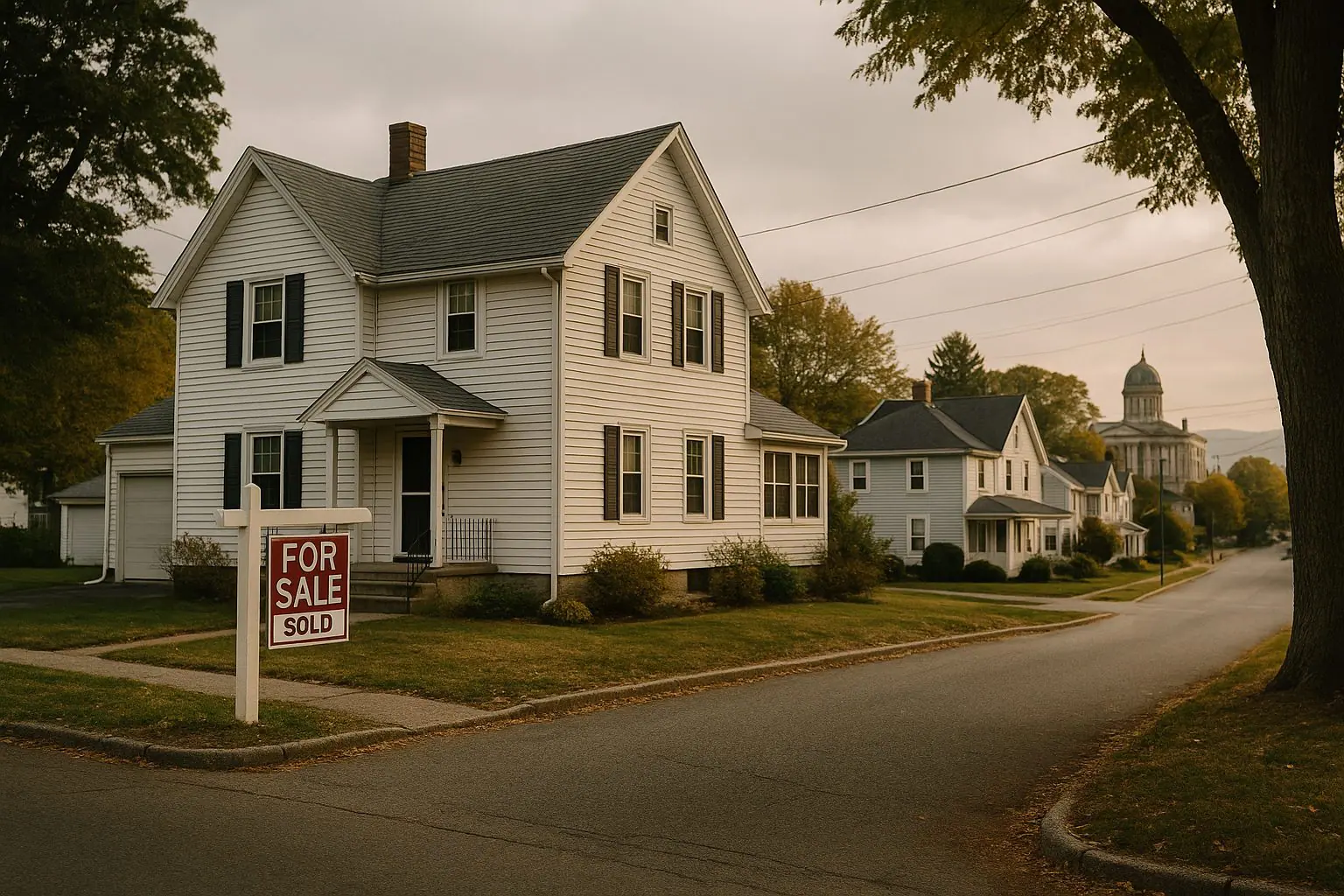
How Long Should You Own a Home Before Selling in Millville
There is no correct number of years. There is arithmetic you can do, and there is a list of things a Millville seller has to line up early — longer here than in a town on municipal services, because most of what a buyer will test is underground and on your property rather than the town's.
This page is about deciding whether to sell yet. If you have already decided and want the town itself described, that is the infrastructure and housing trade-offs of living in Millville.
What is actually behind the five-year rule of thumb
The old advice is to own about five years before selling. Three real things sit underneath it.
- You pay transaction costs twice — once buying, once selling — and those costs do not care how long you owned.
- Amortization is front-loaded. Early payments on a fixed-rate loan are mostly interest, and the balance falls slowly at first. Get your own amortization schedule from your servicer and look at the actual numbers rather than the general claim.
- Appreciation needs time to clear those costs. Over a short hold the costs are certain and the appreciation is not.
Your own break-even depends on your down payment, your rate, and whether you have refinanced. Calculate yours. Do not inherit somebody else's number.
The arithmetic
What would it sell for? Not an automated estimate. Pull the last six months of closed sales within a mile from MLS PIN, check each against the town assessor's record, and adjust for the real differences — living area, lot, year built, last permitted work, and critically for Millville, which systems the property has. A house on town water is not directly comparable to one on a well, and a recently replaced septic system is not comparable to one of unknown age. A valuation on your own property is the sensible place to start.
What do you owe? Get a payoff quote from the lender, not the balance on your statement.
What does it cost to sell? Brokerage compensation, which is negotiable and set by your agreement; the state deeds excise stamped at transfer, whose current rate your closing attorney can confirm; attorney and recording fees; the smoke and carbon monoxide certificate; final readings; pre-sale preparation; and the credits or repairs you negotiate after the buyer's inspection. Assume that last one will be something rather than nothing.
Then: price, less payoff, less costs, less moving and next-purchase costs. Set the result against what your next move actually requires. If it comes up short, the question is no longer "when" but "what would have to change".
What a Millville seller has to line up early
This is the part that makes the timing question different here. In a town where most properties are on private wells and on-site septic systems, several of the items a buyer will test have lead times measured in weeks, and one of them can have a lead time measured in months.
Septic and Title 5
Massachusetts requires a Title 5 inspection at transfer for properties on septic, with limited exceptions. Book it on your own schedule, well before you list. If it passes, you have removed the largest single uncertainty from your sale and you can say so. If it fails, you have a project — design, permitting through the Board of Health, and installation — and you would rather discover that while you still control the calendar than inside a buyer's contingency period.
Pull the Board of Health file on your own address at the same time: the design plan, the as-built, the pumping and repair history. A buyer's agent will ask for it.
Well testing
A buyer's lender will commonly order flow and potability testing on a private well. Test first, yourself. If treatment turns out to be needed, installing it and retesting takes time that you do not have once a contingency clock is running, and a clean result you can produce up front is worth more than an argument later.
Radon
Radon testing is routine in this region, in air and in some cases in well water. Test in advance so a mitigation decision is a decision rather than an emergency.
The detector certificate
Massachusetts requires smoke and carbon monoxide alarms to meet current requirements, certified by the fire department before closing. The rules turn on the age and construction of the house and they are more specific than most sellers expect. Ask the fire department what your property needs and book the inspection early; a failed certificate at the end is a genuine closing delay.
The permit file
Older housing stock here frequently includes work that never went through the building department. Read your own permit file before a buyer's side reads it, and take advice on anything that looks unresolved — there are usually more options available now than there will be under agreement.
Contractors and inspectors book out
Every item above depends on somebody with a van and a calendar. In a small town, the pool of local septic inspectors, well contractors, roofers and electricians is not large and it fills up seasonally. Pick your target listing month, then count backwards by several months, not several weeks.
Taxes: the question to ask, not an answer to take from an article
Federal tax law provides a capital gains exclusion on the sale of a primary residence, subject to an ownership and use test — broadly, how long you owned the property and how long you lived in it as your main home during a defined look-back period, with partial relief available in some circumstances such as a qualifying change in employment, health or unforeseen events. Massachusetts has its own treatment of the gain.
That is deliberately as far as this page goes. The thresholds, the amounts and the exceptions turn on your own facts and they matter a great deal if you are considering selling after a short hold. Put the question to a tax professional before you list, not after you have an accepted offer. Nothing here is tax advice.
What a short hold actually costs
- Little principal has been repaid, so more of the sale price goes to the payoff.
- The full set of selling costs comes out of a smaller equity base.
- If your existing rate is well below what is currently available, the loan is itself an asset you are giving up — a real cost that never appears on a closing statement.
- You may create a tax position that a longer hold would not have.
- You pay buying costs again on the next property.
- In a town where the pre-sale work list is long, you may be paying for septic, well and certificate work you would otherwise have spread over more years of ownership.
Set against that: a job move, a commute that has changed, a household that has changed, health, a house that no longer works, or equity better deployed somewhere else. All sound reasons, none of which require a round number of years.
When waiting is the better answer
- Your payoff is close to or above a realistic sale price.
- The septic system is of unknown age or condition. Find out first. The answer changes the decision, and it may change it in your favor.
- A major system is at the end of its life. Replacing a roof and then owning for another year or two is usually better arithmetic than selling into that conversation.
- Your income is unsettled. The next purchase still has to be underwritten.
- You have not solved where you are going.
Seasons, honestly
Spring brings the largest buyer pool and the most competing listings at the same time. Autumn is a real second window. Midwinter is slow, and there is a practical reason beyond buyer appetite: snow cover hides roofs, grading and drainage, which makes both inspections and presentation harder. Deep summer is quiet.
None of that outweighs readiness, and in this town readiness has a lead time. A listing that goes live before the septic, the well and the certificate are sorted spends its most valuable weeks managing questions instead of offers.
Before you decide, do these five things
- Get a payoff quote from your lender.
- Build a realistic value from closed sales and assessor records, not an online estimate.
- List your exit costs honestly, including concessions you have not negotiated yet.
- Book the Title 5 inspection, the well tests and the radon test on your own schedule.
- Ask a tax professional about the ownership-and-use question if the hold has been short.
What to do next
If the arithmetic says go, the preparation and pricing sequence is on the selling page, and the work above is what you start first. Millville has no community page on this site, so for the surrounding valley towns the Northbridge community page is the nearest equivalent. When you want a second pair of eyes on the numbers or on the septic file, talk it through with Tim.
Before you rely on anything here
Towns change their bylaws, districts change their enrollment policy, and the market changes faster than any article. Confirm current details with the town department or district office that owns them before you act on them. Nothing here is legal, tax or financial advice.
Tim Harvey Real Estate is committed to the letter and the spirit of U.S. policy for the achievement of equal housing opportunity throughout the nation. We encourage and support an affirmative advertising and marketing program in which there are no barriers to obtaining housing because of race, color, religion, sex, handicap, familial status, national origin, sexual orientation, gender identity, age, ancestry, marital status, veteran status, genetic information, or source of income.
Send Tim a message
Tell him what you're trying to work out. He answers these himself.