
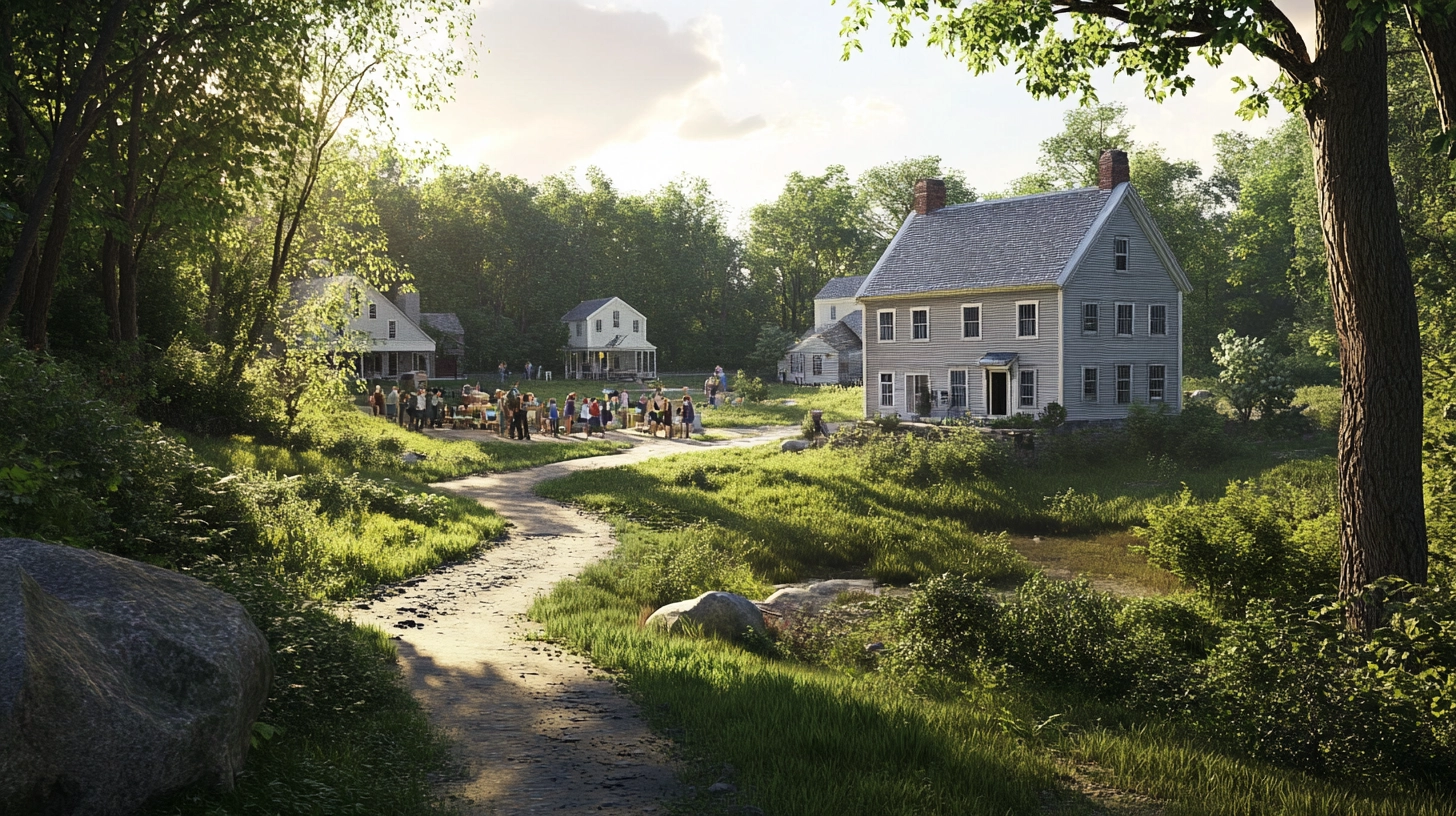
Pros and Cons of Living in Millville Massachusetts
Millville is one of the smallest towns in Worcester County, and the honest version of its trade-offs is entirely about infrastructure and housing: what the town provides and what it does not, how far you are from the things it does not have, what is under the ground, and how old the buildings are.
That is what this page covers. It does not tell you who the town is for. Nobody can tell you that, and an article that tries is telling you about its author rather than about the town.
Where it is, and how it came to be this size
Millville sits at the southern edge of Worcester County on the Rhode Island state line, in the Blackstone River valley between Blackstone and Uxbridge. It covers roughly five square miles of land — small enough that almost nothing in town is far from anything else in town.
It is also young as Massachusetts towns go: Millville was incorporated in 1916, separating from Blackstone. That single fact explains a great deal about how the town works today, because several arrangements that would normally be a town's own are still shared with, or regionalised alongside, its neighbors.
Route 122 runs through the town, and Route 146 and I-495 carry the regional traffic nearby. Providence, Worcester and Boston are all drivable and none of them is close. Time your own commute at the hour you would actually drive it; a mapping app at midday is not information.
The case for it: what the town actually has
Land, for the price of the housing. Lot sizes here are generally residential-scale rather than estate-scale, but you are buying land in a town where land is not priced as it is twenty minutes north. What you can do with a lot is governed by the zoning bylaw and, where wetlands are involved, by the Conservation Commission — read both before you plan an outbuilding, a pool or an addition.
Open town meeting. Millville is governed by open town meeting with a Board of Selectmen. In a town this small, a single warrant article genuinely moves things, and every registered voter can vote on it. The warrant is the best available forecast of what happens to your street.
The Blackstone River valley. The river corridor and its trail network are the town's main open-space asset, and the corridor has seen sustained public investment in trails and river access. Check which segments are actually open and where the trailheads are before assuming a route exists.
A second public high school pathway. Millville is a member town of the Blackstone Valley Regional Vocational Technical School District, whose high school is in Upton. That is a separate district with its own application process and its own calendar, and it is a genuine structural option rather than a perk.
Everything in town is close to everything else in town. In five square miles, the town hall, the elementary school, the library and the transfer arrangements are all a short drive. That is not nothing when the alternative is a sprawling town with the same number of services spread over thirty square miles.
The trade-offs: infrastructure, systems and stock
These are the things that will actually shape your experience of owning here, and every one of them is checkable before you buy.
Water and sewer coverage is limited
Municipal water serves only part of the town; most properties are on a private well. Wastewater is largely on-site septic rather than municipal sewer. Confirm the position for a specific address with the town's water department and the Board of Health — never from the street or the listing. Ask the water department for the most recent annual water quality report and current testing results while you are there. If you have children who will attend school in town, the school buildings draw on their own supply rather than the town's, so that is a separate question for the Blackstone-Millville district office.
What that means in practice: on septic, Massachusetts requires a Title 5 inspection at transfer, with limited exceptions, and a failure is a five-figure project with a lead time. On a well, you are responsible for testing and for treatment, and a replacement well is a major expense. Ask the Board of Health for the septic file and the well record on any address you are serious about.
Water quality is an active subject in this town, as it is in many small Massachusetts water systems. Ask the water department for the current annual water quality report and for recent testing results, and if the property is on a private well, test it yourself rather than relying on anything town-wide.
A small tax base pays for a small set of services
This is the honest structural trade-off and it explains most of the others. A town of five square miles with a modest commercial base has limited revenue, and that shows up in what the town can staff and maintain: road reconstruction schedules, plowing priorities on side streets, department hours, capital projects.
It also means that when something large is needed — a building, a system, a piece of equipment — it tends to arrive as a debt exclusion or an override at town meeting rather than absorbed quietly into an operating budget. Before you buy, read the last two town meeting warrants and the capital plan. They will tell you what is coming and roughly what it will cost you.
Most services and most jobs are in other towns
The commercial base in Millville is small. Groceries, pharmacies, general retail, most medical services and most employment are in neighboring towns and in the nearby cities. That is a distance-and-time cost, and it is a real one — count the drive to the things you actually do weekly, not the ones you imagine doing.
No rail service in town, and a car is not optional
There is no commuter rail station in Millville and no meaningful fixed-route transit. Rail into Boston runs from stations in other towns. Plan on driving, plan on parking, and check station parking capacity at the hour you would arrive rather than assuming a space.
The housing stock is old in parts, and that has consequences
A significant share of the housing here dates from the mill era, with newer construction layered in over later decades. Older stock in this region routinely carries knob-and-tube or ungrounded wiring, older heating systems, stone or fieldstone basements, and additions whose permit history is worth reading at the building department before you assume the square footage is legal square footage.
The valley floor also means groundwater. Look at basements with a flashlight, look for the staining line on the walls, ask about sump pumps and where they discharge, and go back after heavy rain if you can. A stone basement that has been painted is a question, not an answer. This is the sort of thing learning to evaluate a property properly is for.
Broadband varies by address
Service quality is not uniform across a town with this road pattern. If you work from home, verify what is actually available at the specific address with the provider, and ask the seller what they have.
Schools: the structure, and where to check it
Millville does not run its own K–12 district. It shares the Blackstone-Millville Regional School District with the town of Blackstone. Elementary students attend Millville Elementary in town; the district's middle and high schools are in Blackstone, and the district's published grade bands place the elementary years, the middle years and the high school years across those buildings.
Confirm the current grade spans, placement, transportation and registration requirements with the district office, because regional districts do change building assignments. Pull performance data yourself from the Massachusetts DESE School and District Profiles rather than from any third-party score. As noted above, Blackstone Valley Regional Vocational Technical High School in Upton is a separate district with a separate application.
That is the whole of what this page will say about schools, deliberately.
How to price a Millville house
Do not price from a town figure. The housing stock spans a century and a half and the systems vary house to house — town water or well, sewer or septic, updated or original. Pull the last six months of closed sales within a mile of the property from MLS PIN, open the town assessor's record for each one, and compare what actually sold: living area, lot, year built, last permitted work, and which systems it has. Closed sales are the only prices that mean anything; list prices are asks and automated online valuations have never been in the basement. Running the search properly is most of the work.
If you are weighing how long you would need to own before selling made sense, that arithmetic is worked through in how long to own a Millville home before selling.
What to do next
Three calls will tell you more than another month of reading: the water department about a specific address, the Board of Health about its septic and well records, and the building department about its permit file. Then read the last town meeting warrant. Millville does not have a community page on this site, so for the neighboring towns in the valley start with the Northbridge community page. When you want to talk through a particular property, get in touch with Tim.
Before you rely on anything here
Towns change their bylaws, districts change their enrollment policy, and the market changes faster than any article. Confirm current details with the town department or district office that owns them before you act on them. Nothing here is legal, tax or financial advice.
Tim Harvey Real Estate is committed to the letter and the spirit of U.S. policy for the achievement of equal housing opportunity throughout the nation. We encourage and support an affirmative advertising and marketing program in which there are no barriers to obtaining housing because of race, color, religion, sex, handicap, familial status, national origin, sexual orientation, gender identity, age, ancestry, marital status, veteran status, genetic information, or source of income.
Send Tim a message
Tell him what you're trying to work out. He answers these himself.