
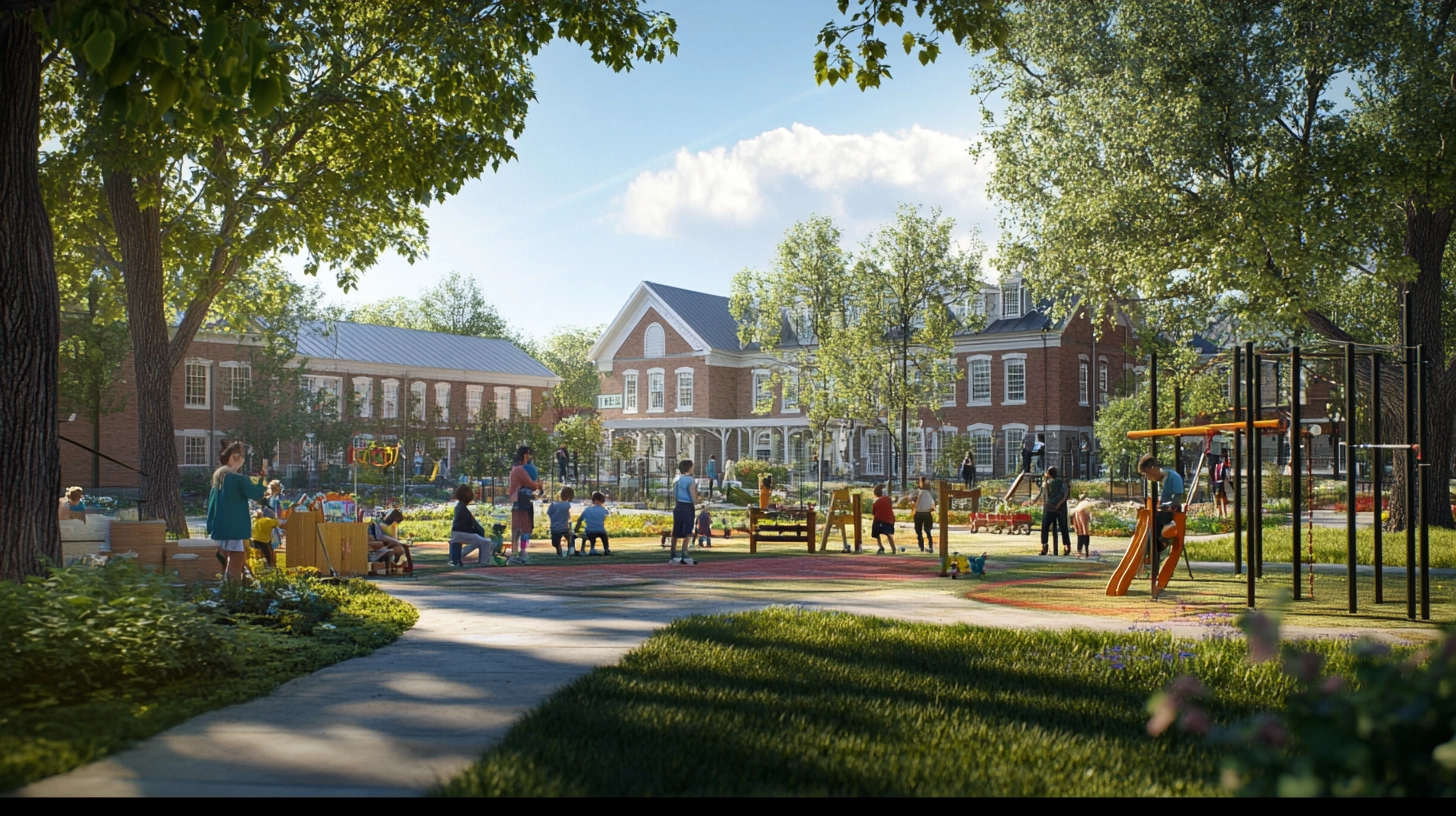
Schools in Upton
This page is a factual reference, not a ranking. It sets out which district Upton belongs to, which building a student attends at which grade, which admissions run on a separate process, and where the official data lives so you can read it yourself instead of taking anyone's word for it — including ours.
Nothing here grades a school or compares one town's schools to another's. That is deliberate. School quality is a judgment you make from the source data and your own visits, and third-party letter grades compress a great deal into a number that usually will not survive contact with your actual question.
The district Upton belongs to
Upton and Mendon share the Mendon-Upton Regional School District. A regional district means the two towns operate one school system together: one superintendent, one regional school committee with members elected from both towns, and one budget that each town funds through an assessment. That assessment is voted at each town's annual town meeting, which is where the school budget is actually decided — not at the school committee table alone.
The practical consequence for a buyer is that Upton's school system is not Upton's alone. Decisions about buildings, programs and the operating budget are made jointly with Mendon, Upton's partner town in the regional district, and either town's meeting can shape the outcome.
The grade progression
Upton students move through the district in this order:
- Memorial Elementary School (Upton) — through grade 4
- Miscoe Hill School (Mendon) — grades 5 through 8
- Nipmuc Regional High School (Upton) — grades 9 through 12
On the Mendon side, Henry P. Clough Elementary School serves Mendon's youngest students before the two towns converge at Miscoe Hill in grade 5. So Upton and Mendon students are in separate elementary buildings and then in the same building from grade 5 onward.
The Town of Upton publishes this progression on its own website, and the district office publishes it too. Grade configurations do get changed — districts consolidate buildings, move a grade, or redraw an assignment — so confirm the current arrangement with the district office rather than with a listing description or an article, this one included.
The vocational high school is a separate admission
Blackstone Valley Regional Vocational Technical High School is located in Upton. It is a separate regional vocational-technical district with its own member towns, its own school committee and its own budget, and Upton is one of the member towns.
Membership does not mean automatic enrollment. Admission to a regional vocational-technical school runs through an application and an admissions policy, and it happens on a timeline during middle school that is easy to miss if you move into town partway through. If a student in your household is considering it, ask the vocational school's admissions office for the current policy and the current deadline in writing. Do not rely on a general description of how it worked in a previous year.
School choice and charter admission are also separate
Two other routes exist, and neither of them follows from your address:
- Inter-district school choice lets a student attend a district other than the one they live in, but only where the receiving district has voted to accept choice students and only where seats exist. Districts vote on this each year and can close it. It is not a right attached to a house.
- Commonwealth charter schools are public schools that enroll by lottery from a defined region, not by town assignment. Getting in is a matter of the lottery, and the transportation arrangement is a separate question you should resolve before you accept a seat.
The common mistake is to assume that because an option exists nearby, it is available. Buying a house does not buy a seat in anything except the district your address is assigned to, and even that assignment is the district's to confirm.
Where the official data lives
If you want to evaluate the schools rather than be told about them, go to the primary sources:
- Massachusetts DESE School and District Profiles — the state's own database, published per school and per district. Enrollment, class size, staffing, per-pupil expenditure, MCAS results, graduation and dropout figures, and what graduates reported doing after high school. This is the dataset every third-party score is derived from, and reading it directly costs you nothing and loses no detail.
- The district office — current assignment for a specific address, enrollment paperwork, bus eligibility and walk distances, program availability, and anything about a particular student's situation.
- School committee agendas and minutes — where you find out what is actually being discussed: building projects, budget pressure, staffing changes, grade reconfiguration. Public record, posted in advance.
- The annual town meeting warrant — the school assessment and any debt exclusion or override for a school building project appear here before they appear on your tax bill.
Reading the numbers without being misled by them
A single year of results from a small district moves for reasons that have nothing to do with teaching — a small cohort, a change in participation, a testing change at the state level. Look at several years rather than one. Look at the same measure across grades rather than a headline. And separate what the data says from what a marketing page says it says.
If you want the longer version of that method — how to compare districts honestly, what enrollment and school choice actually determine, how to read a profile page section by section — that is the job of the walkthrough of how to evaluate a district yourself. This page is the short reference; that one is the method.
Schools are one input, and the house is another
Whatever you conclude about the district, the house still has to hold up on its own. In Upton that means private well and septic on many properties, a Title 5 inspection at transfer, older housing stock with the wiring and heating questions that come with it, and lot and road conditions that vary a great deal within the same town. Those are the things an inspection and the town's own records answer, and they are covered in how to evaluate a house here before you make an offer.
For the town itself — how Upton is governed, what the town provides, what the different parts of it are like — start with the Upton community page.
What to do next
Call the district office and get the current assignment for any address you are serious about, in writing. Pull the DESE profile for each building yourself. If you want help lining that up against specific properties and the questions they raise, talk it through with Tim before you are under contract rather than after.
Before you rely on anything here
Towns change their bylaws, districts change their enrollment policy, and the market changes faster than any article. Confirm current details with the town department or district office that owns them before you act on them. Nothing here is legal, tax or financial advice.
Tim Harvey Real Estate is committed to the letter and the spirit of U.S. policy for the achievement of equal housing opportunity throughout the nation. We encourage and support an affirmative advertising and marketing program in which there are no barriers to obtaining housing because of race, color, religion, sex, handicap, familial status, national origin, sexual orientation, gender identity, age, ancestry, marital status, veteran status, genetic information, or source of income.
Send Tim a message
Tell him what you're trying to work out. He answers these himself.