
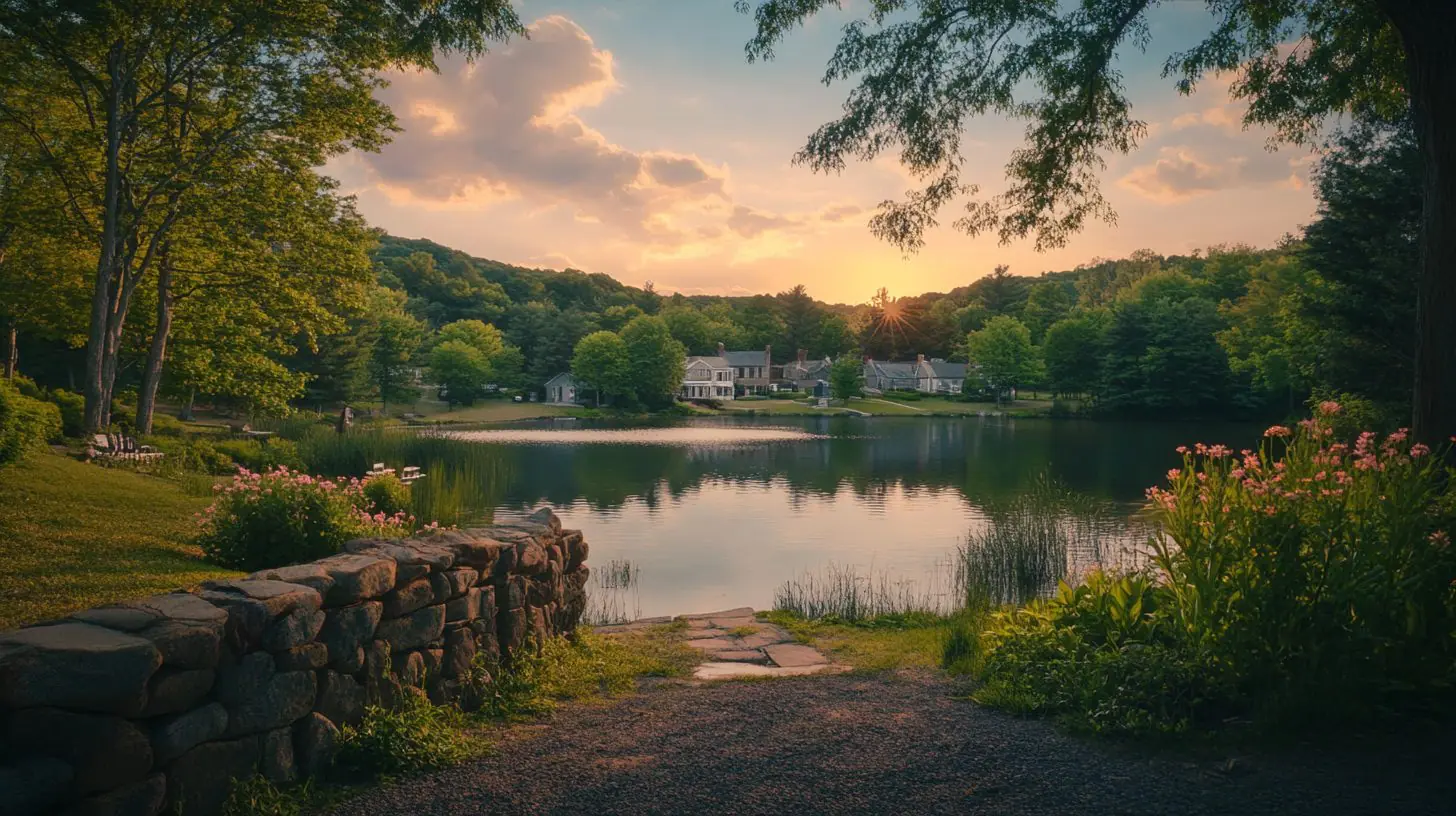
Discovering Upton, MA: A Charming New England Town
"Charming New England town" is a phrase that usually means nothing. In Upton it means something specific and checkable: a town that was built by a hundred years of boot and shoe manufacturing, then by straw braiding and hats, then by a railroad, and which still has the buildings to show for it. This article is about that history and what it left behind — because what it left behind is the housing stock you would be buying.
Why the town exists at all
Europeans settled the area in 1728, and Upton was incorporated in June 1735 from land taken out of Hopkinton, Mendon, Uxbridge and Sutton. The reason, according to the town's own history, was practical and slightly mundane: residents on the outer edges of those four towns found it difficult to meet the obligation to attend church every Sunday, and petitioned for a new town centered closer to where they actually lived.
That origin explains the shape of the place. Upton's boundaries are irregular because they were carved from four neighbors, and some of its older roads still run toward those neighbors' centers rather than toward its own. If a boundary matters for a specific parcel, the recorded plan at the Worcester District Registry of Deeds and the assessor's record are the authorities.
A century of boots and shoes
The town's main industry for roughly a hundred years was boots and shoes. Between about 1730 and 1850 Upton had a large number of small shoe shops — known as ten-footers, for their approximate dimensions — which were gradually consolidated into larger assembly-line manufacturers. The town's history page states that in 1837 Upton's factories produced 21.7% of all the boots manufactured in Worcester County.
A ten-footer was a small detached outbuilding where a few people worked at a bench. They were built by the hundred across southern New England and most are gone, but some survive, moved, re-sided and repurposed as sheds, garages and studios. If you are looking at an older Upton property with an odd small outbuilding that does not quite make sense as a barn, that is worth asking about. It is also worth checking what it is legally — an outbuilding's permitted use, its setback and whether it predates zoning are Building Department questions, and "it's always been there" is not a legal status.
Straw braiding and the hat factory
From 1860 the town's industrial center of gravity shifted to hats and bonnets. The groundwork was a cottage industry: women across Upton braided straw hats at home. In the 1830s William Knowlton began consolidating that home work into shops and then into a factory. The town's history describes the result as, for some ninety years, the largest hat industry in the world, employing close to a thousand workers.
The relevant point for anyone looking at property is what a factory of that size does to a small town's form. It concentrates housing near the work. Nineteenth-century mill and factory towns are dense at the center and abruptly rural beyond it, and Upton still reads that way — a compact older core at Upton Center and at West Upton, and then farmland, woodland and large-lot housing outside it. The Knowlton factory building itself still stands and has been rehabilitated for residential use.
The railroad
Rail reached Upton in 1873 with the Grafton and Upton Railroad, which is a significant part of why the town industrialized when it did and why the older commercial buildings sit where they sit. The line still exists as a short-line freight operation rather than a passenger service. Upton has no MBTA commuter rail station, and it has not had passenger service in a very long time — which is a genuine constraint on commuting rather than a piece of charm.
What the history left you to buy
Upton's housing stock is unusually stratified by era, and each layer comes with a different set of questions:
- Pre-1850 farmhouses and center-village houses. Post-and-beam or early balloon framing, stone or fieldstone foundations, plaster over lath, chimneys that may never have been lined, and sills that have had a hundred and fifty years to find moisture.
- Later nineteenth-century factory-era housing. Closer to the centers, on smaller lots, often altered repeatedly. Look hard at what was added and when.
- Mid-twentieth-century houses. Capes and ranches, frequently the ones carrying original wiring, original oil systems and original single-pane windows.
- Later subdivision and recent construction. Larger lots further out, usually on private well and septic, with a different set of obligations rather than fewer of them.
Owning an antique house here: the actual checklist
People fall in love with the old houses and then find out what they signed up for. None of this should stop you — plenty of these houses are excellent — but go in knowing:
- Wiring. Knob-and-tube and ungrounded circuits are common in pre-1950 stock. Both are insurance problems as well as fire-risk problems; ask your insurer what they will write before you are under agreement, not after.
- Heat. Oil, gas, propane and heat pumps all appear here. A buried oil tank is a liability question, not just a heating question, and a removed tank should have documentation.
- Lead paint. Massachusetts law requires disclosure for pre-1978 housing, and requires deleading when a child under six occupies the home. That is a legal obligation attached to the property. Find out the property's deleading status in writing.
- Asbestos. Pipe insulation, floor tile, siding shingles. Common in this era and manageable, but it should be identified rather than discovered.
- Foundations and water. Fieldstone cellars, ledge, and the wet basements that come from both. Look at grading and gutters, and look in the spring if you can.
- Chimneys and flues. Unlined or deteriorated flues are a frequent and expensive finding on houses of this age.
- Permit history. Additions, finished basements, dormers and decks built without permits are common on long-held properties. The Building Department has the record and it is public. An unpermitted addition is a problem you inherit.
- Septic and well. Massachusetts requires a Title 5 inspection at transfer for properties on septic, with limited exceptions. On an older lot, a failed system can mean a design constrained by the lot itself.
- Historic district status. This is the one most people get wrong. Listing on the National Register is honorific and does not by itself restrict what you do to your house. A local historic district, adopted by town meeting and administered by a commission, does — exterior changes visible from a public way can require review before you do them. Find out which, if either, applies to a specific address before you plan a project.
The general version of this inspection-and-records work, and the order to do it in, is in how to evaluate a house here before you make an offer. The specifics above are what the local age of the housing stock adds to it.
Open space, and the pond
The town maintains Kiwanis Beach on Pratt Pond, and Upton State Forest covers roughly 2,800 acres of state-owned land, primarily in Upton with sections extending into Hopkinton and Westborough. The state forest contains the last remaining Civilian Conservation Corps camp in Massachusetts, which is another piece of the town's built history rather than only a piece of scenery. The town has also added conservation land by purchase over the years.
If protected land next to a property matters to you, confirm what is actually protected through the Conservation Commission and MassGIS. Undeveloped is not the same as protected, and only one of those two conditions is durable.
The town underneath the history
How Upton is governed today, what its departments do, and which office answers which question is the subject of the plain orientation piece on how Upton is governed and what the town provides. How the different parts of the town differ in lot size, road type, housing era and distance to the center is covered in the geography of Upton's different areas. And the town-level summary sits on the Upton community page.
What to do next
If an older Upton house has your attention, do three things before you write an offer: pull the assessor's property record card, read the Building Department's permit file for the address, and find out whether any local historic district review applies. Then get an inspector who has worked on houses of that age specifically. If you want help lining up what a particular property is likely to need, talk it through with Tim first.
Before you rely on anything here
Towns change their bylaws, districts change their enrollment policy, and the market changes faster than any article. Confirm current details with the town department or district office that owns them before you act on them. Nothing here is legal, tax or financial advice.
Tim Harvey Real Estate is committed to the letter and the spirit of U.S. policy for the achievement of equal housing opportunity throughout the nation. We encourage and support an affirmative advertising and marketing program in which there are no barriers to obtaining housing because of race, color, religion, sex, handicap, familial status, national origin, sexual orientation, gender identity, age, ancestry, marital status, veteran status, genetic information, or source of income.
Send Tim a message
Tell him what you're trying to work out. He answers these himself.